INTRODUCTION
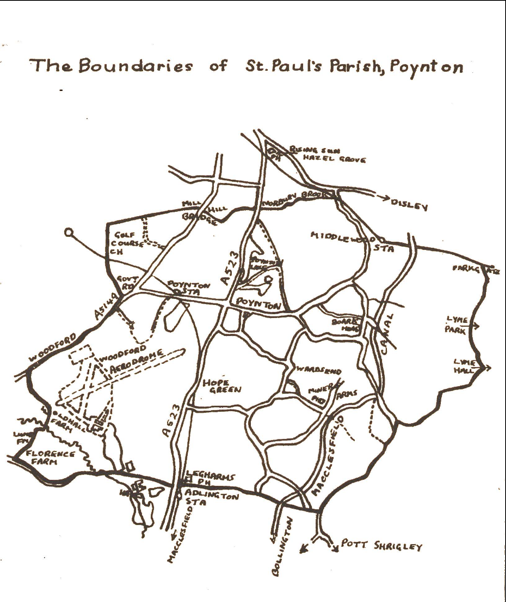
The Parish of St. Paul’s, Poynton, takes in the whole of Poynton-with-Worth and Higher Poynton, as well as those parts of Woodford and Adlington which are indicated on the map below. The map is based on the document sent by Bishop Murphy to Fr. Lynch on 15th. February 1959, now in the Presbytery Files. It is a parish of the Catholic Church, and what follows, deals not with the whole history of the district, but only with those details in it that are linked closely with the Catholic Faith and its adherents in this area. This summary was originally written to mark the Silver Jubilee of the foundation of St. Paul’s Parish in September 1957, with elements added to include more recent times.
ANCIENT CONTEXT, UP TO 1939
From ancient times until the beginning of the nineteenth century there were, as far as is known, very few people living in this district. It was formed part of the Forest of Macclesfield. This means that long ago it was doubtless thickly wooded, but for many centuries during the Middle Ages it consisted mainly of rough pastureland interspersed with frequent trees. It was used mainly for hunting by the privileged few who owned the land. These built themselves splendid residences with lovely parks and they had large numbers of retainers to act as servants and to look after their property.
It is believed that there are traces of an old Roman road under the present Meadway Estate, but what is more certain is that, from early Roman times when the Christian Faith first came to these lands until the reformation, everybody in this whole area and in every other part of England was Catholic, except for the invading pagans, who eventually became Catholics too if they stayed long enough.
For that reason, the most ancient church in this area is of great interest to us. It was Poynton Chapel which we know, from existing documents, was already here before the year 1312. It was situated near Poynton Pool quite close to the present junction of South Park Drive and Towers Road. It was small but beautiful, with lovely stained glass windows. It served the gentry and the ordinary people of Poynton, Worth and Woodford. It was dedicated to Our Lady and it remained a Catholic church till about 1600. It was rebuilt in 1789 and then dedicated to St. George. When the present church of St. George was built about half a mile away in 1858 the ancient chapel was pulled down. An interesting little fact is that the present Parish Church is called “St. Mary’s” on the brass plate in its foundation stone, because of its link with the old chapel. Norbury Chapel which stood just outside the Poynton boundary, close to the Brookside Garden Centre was never Catholic, being built only around 1600.
The will of Lawrence Warren who owned all Poynton and much of Stockport gives an interesting insight into the Catholicity of this district during the reign of Henry VIII. The will is dated 1529– Lawrence died the following year– and in it he bequeathed his soul to Almighty God, Our Lady St. Mary and all the blessed Company of Heaven, and he asks for thirty Masses to be offered immediately after his death and another five in honour of the Five Wounds. You really cannot get much more Catholic than that!
His descendants, however, eventually accepted the Protestant faith, though we do not know when. At the time of the Jacobite invasion of England in 1745 Bonnie Prince Charlie passed close to Poynton on his way to Macclesfield after the capture of Manchester and Stockport. It was then that the Warrens of Poynton together with all the Lords of Cheshire and Shropshire made the definitive decision to break finally with the “Old Faith” when they opted to support the Hanoverians. This meant that all their dependants became firmly Protestant, if they were not that before.
About 1550 Poynton Hall was built close to the Pool, though there may have been earlier buildings on the same site. It was replaced about 1750 by a much larger house, which in its turn was pulled down about 1830. No new hall took its place, but a large house was built between the two towers of the old entrance-gate, very near to Poynton Chapel. This new dwelling was aptly named “Poynton Towers” and it was still in existence well into this century. Just outside the Park entrance stood the Vicars House, on the Stockport side of the present “Bulls Head”, and almost touching it was a row of nineteen cottages for the workers attached to the Hall. They were built around 1700 and they were the original “Poynton”. The only road out of it was a track known as “Lane Ends” which later became Vicarage Lane and led direct to the Chester Road, now called Woodford Road, Poynton. The present road from the “Rising Sun” to Macclesfield was built as a Toll Road in 1762, mostly at the insistence of the inhabitants of Bullock Smithy as the present Hazel Grove was then called. Apparently the original “Hessell Grave” was a gravel quarry belonging to Mr. Hessell near High Lane.
The Warren Family were the Lords of Stockport, Poynton and other places from 1340 until the death of Elizabeth Harriet Warren, the childless wife of Viscount Bulkeley, in 1826. She bequeathed her Stockport and Poynton estates to the Vernon Family on the apparently mistaken opinion that they were her blood relations. Her father Sir George Warren had bought the Worth Estates in 1792 from the impoverished Downes Family for the sum of £27,000. It was a vast sum in those days, but it was a shrewd buy. Coal was the gold of the dawning Industrial Revolution, and Worth unlike Poynton was extremely rich in coal, good coal and relatively easy to mine. The Warren Family owned most of Stockport with all its mills and, at the start of the Steam Age, Sir George had foreseen the importance of having one’s own supply of coal. This brought great wealth to the family and then later to the Vernon’s when they succeeded to the estates in 1826. As new mines were opened more miners had to be found for them and these needed houses. The first miner’s cottages were built up Middlewood Road, near the new mines, and then more in Park Lane. When the first school was opened in 1845 Poynton Green had become the centre of the village in place of the few cottages at the Park Gates.
By then Poynton was becoming an important village. In the Middle Ages, Hepley and Lostock were little hamlets, but in the early nineteenth century they were swallowed up by the growing Poynton-with-Worth. By 1801 it already had 114 houses and 620 inhabitants. All through the nineteenth century it continued to grow as more mines were opened, and by 1901 there were 525 families and 2544 persons. The Village consisted of two main roads, London Road and Park Lane, but gradually all round these roads other houses were built, though right up to the last War there were lots of empty spaces, and even more recently there were crops growing and cows grazing on what are now established estates. Everything in the Village centred on what one writer described as the inexhaustible veins of the best coal. Thus, Poynton never was a truly rural village. It came into existence as a mining village.
It is possible that an occasional Catholic lived in the area, but by and large Poynton was solidly Protestant. This was almost unique for an industrialised community in Great Britain because all through the nineteenth century the poverty stricken, work hungry Irish workers had swarmed into all the heavy industries, and with them they brought the Catholic Faith. That this did not happen in Poynton, as it did in Stockport, Macclesfield and Bollington, can only have been the result of a set policy of not employing Catholics on the part of the Warren and Vernon families.
Mr. Roy Dudley who supplied much of the above information recalls his father saying that a Catholic lived and worked in Poynton in the early years of this century, but it was not until 1914 that the first known Catholic arrived, and by that time Lord Vernon had left. They were Thomas and Teresa Whitehead who in that year moved into 64 Park Lane with their three children. Three more were later born to them in Poynton. The children attended Poynton Green School, now the Social Centre in Park Lane, and for a time the family attended services in the Parish Church on the assumption that it was the nearest thing they could find to a Catholic Church. In those days Poynton was in the Catholic parish of Edgeley, Stockport, though there was a chapel-of-ease in Commercial Road, Hazel Grove, which the Whiteheads do not seem to have known about.
In 1924, however, Mrs Whitehead – by then a widow, was told of the new parish of St Peter’s that had started in Hazel Grove the preceding year, with Father Kirby the first Parish Priest. About the same time, she discovered another Catholic in Poynton, Mrs Massey who lived in Clumber Road just opposite the old cinema. Between them they arranged with Mr Hallworth who owned a taxi to take the two ladies and the five remaining children to the 8 a.m. Mass in St Peter’s, Commercial Road, every Sunday morning. In 1931 the new church of St Peter’s in Green Lane was opened by Fr Kelly who had succeeded Father Kirby. By then the taxi owner was using a converted army lorry as a bus to take them all to Mass and the children to Sunday School. In 1934 Mrs Whitehead achieved her long-cherished ambition when she moved into a house near the Catholic Church in Hazel Grove. The above information was given in a letter from one of her daughters now living in Dublin. She added that all the Whitehead children married Catholics and that all their children and grandchildren are Catholics. She also mentioned that before they left Poynton two other Catholics had come there, Mrs Johnston and Mrs Hargreaves, but the writer could not find out anything about them.
However, he does know another Catholic who arrived in Poynton in 1931. She is Mrs Agnes Clayton who lived at 51 Copperfield Road. Her first house here was one of the nineteen cottages at the end of Vicarage Lane, and she stayed there until they were all pulled down in 1937. In 1932 Mr and Mrs Talbot came to Wayside Drive with their two sons. The following year the Molloy family moved into Woodford Road, Poynton.
By 1934 the unthinkable had happened. The “inexhaustible Poynton coal” had run out and the mines were closed. In that same year the first of the Quinn sisters from Cleaton Moor in Cumbria came to Poynton. She was Mrs Williamson who until 1953 lived in 17 Bulkeley Road. There over the next few years she received three more of her sisters, including Mrs Lloyd and Mrs Bennett. A few more Catholics who have since died or left the district also lived in or around Poynton in those pre-War years but the total number, including the lapsed was probably less than thirty. They all formed part of the parish of St Peter’s Hazel Grove, and by 1936 Fr Kelly, the Parish Priest, felt he must do something for the Catholics in Poynton.
On Easter Sunday that year Mass was said for the first time there in the home of Mrs Crush who lived in 82 Chester Road. The following Easter Sunday and again later in that year of 1937 Mass was said in the “Kindergarten” at 62 Chester Road. Soon afterwards Fr Kelly hired a bus from Swan’s Chip Shop in Park Lane to take the Catholics to the 8 a.m. Mass every Sunday at St Peters. This however was not very successful. It was very early, especially for those Catholics who had to walk a long way before getting on the bus. Fr Kelly decided to rent the “Corner Café”, which became the Post Office, for Mass every Sunday. This went on for about eighteen months. Sometimes as many as forty would be present at the Café-Mass, but mostly there would be far less.
THE CINEMA CHURCH 1939—1941
The first cinema in Poynton had been opened in 1922. It was built by Mr Bailey on land that until then had been an orchard. It was situated at the junction of Clumber Road and the “new” Bulkeley Road opened in 1902. In 1923 Mr Bailey constructed a small cottage next to the cinema with a shop attached to provide his patrons with sweets and tobacco. Together and enlarged they now form the Presbytery. The newly built house and shop were bought by Mr and Mrs Casemore who stayed there until 1936. In that year they rented the premises to Mr and Mrs White who lived there till Mrs Casemore sold it to Fr Hurley in 1963. Mr and Mrs White then moved to 16 Brookside Avenue, while Mrs Casemore lived in Shrigley Road. The cinema proved so popular and profitable that Mr Bailey decided about 1937 to build a bigger and better one on London Road which he called the “Brookfield”, which was on the site of the Aldi supermarket. The mosaic on the front elevation of the supermarket makes reference to the site cinema heritage.
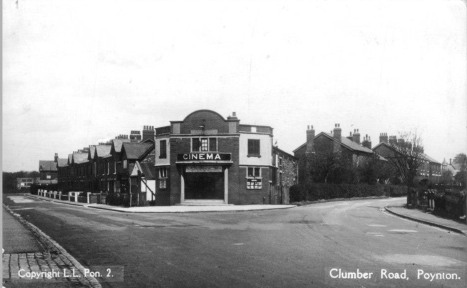
As far as the writer can judge, when the cinema became vacant it does not seem that Fr Kelly or anybody seriously considered turning it into a church. The Catholics were so few and cinemas, especially the early cinemas, are notoriously difficult to convert into anything. Fr Kelly stayed in St Peters until 1946 when he became Parish Priest of St Werburgh’s, Birkenhead where, as Canon, he died in 1972. Like all Parish Priests of the time, he must have written his weekly notices in what we called “The Notice Book”. These books were usually the main source of information concerning the history of the parish. Unfortunately, all the Notice Books of St. Peter’s between the years of 1936 till about 1950 are missing, and this is a grievous loss for the history of St. Paul’s Poynton. They must contain many things of interest to us and from them we would be better able to reconstruct exactly what happened here in those vital years of our history. What follows is the story as far as the writer can reconstruct it from some quotations, bills and letters that Fr Peters, the present Parish Priest of Hazel Grove, found for him; from the memories of Fr Wrangham, a Salesian priest who lived at their College in Pott Shrigley who came from there to say Mass for the evacuee children in Poynton; and from the memories of Mrs Derbyshire who, as Miss Margaret Egan, was one of the teachers with the evacuees.
On the morning of Friday, 1 September 1939, two days before the outbreak of war, six teachers and about two hundred children from Sacred Heart School, Gorton, Manchester, met at Belle Vue Station at 5 a.m. for an unknown evacuation centre. The same thing was happening all over the country, though perhaps at a more reasonable time and perhaps with some knowledge of where they were going to. One of the six teachers Mrs Monica Brennan, with the help of her teacher husband who was also being evacuated, though to a different place, had spent all the preceding days closing up their home in preparation for an indefinite absence. On the morning of 1 September, she said goodbye to her husband and turned up with the rest at Belle Vue Station. At 7 a.m. teachers and children were deposited at Poynton Station which was about 100 yards from the Brennan home at 80 Chester Road. That same lady had made history of another kind a few years earlier when she had contested in the civil courts the then prevalent custom of dismissing a lady teacher on her marriage. She won her case against the managers of Sacred Heart School, which was why she was with the evacuees that morning. She stayed in Poynton till her death there in 1960.
The evacuees were all given food in a nearby hall, and the rest of the day was spent trying to get the children and teachers fixed up with Poynton families willing to take them. About fifty boys and one teacher went to the Salesian College and the rest eventually found accommodation in Poynton-with-Worth.
Mr Hughes, the Headmaster, was a very worried man; and one of his big worries was how he was going to get his teachers and children to Sunday Mass in a place that had no Catholic Church. We can presume that he contacted his own priest in Gorton and also the local Parish Priest in Hazel Grove. We know for certain that he eventually contacted the Salesians in Pott Shrigley to say that he had managed to hire a disused cinema and would they provide a priest to say Mass for them. On either the first or second Sunday after their arrival the Salesians sent Father Slyth to say Mass for the Poynton evacuees, and he did the same for the next one or two Sundays. Then Fr Wrangham took over the task and went every Sunday for nearly two years. Mr Hughes would collect and bring him back by car, and Mrs Massey from Clumber Road would give him his breakfast. In those days one “fasted from midnight” before going to Communion.
On Saturday, 2 September 1939, the mothers and children under five arrived in Poynton from the Sacred Heart Parish of Gorton, and these too were given lodgings in the village. Most of them, however, did not stay long, partly because of family reasons and partly because of the problems caused by having to share the kitchen and all the other facilities with the “lady-of-the-house”. In those days Poynton was, as it had been for the preceding century, basically a mining village and the vast majority of the people were poor, living in fairly primitive conditions. Most of the evacuee children stayed however, though there was always a thin trickle of them going home for good, especially when the expected blitzes and bombing failed to materialise for the first year of “the phoney war’, as the Americans called it. Clumber House in Dickens Lane was the official Sick Bay for all the evacuees during the whole of their stay in Poynton.
At first the Sunday Mass in the old cinema seems to have been exclusively for the evacuees and their relations. The building, which was only rented, was exactly as it had always been, except for the altar erected in front of the screen. The aisles sloped sharply and the seats, to the delight of the children, tipped up and were “plush”. There were toilets at the back, which was another novelty for children at Sunday Mass.
Schooling too had its problems. At that time the Vernon School was the only one in Poynton. From September 1939 until about the end of May ’40, it was a State school in the morning and a Catholic school in an extended afternoon for one week, and then the following week the morning was for the Catholics and the afternoons for the Poynton children. The teachers from both schools were expected to fill in the missing school-hours each day by taking their children for games, nature walks etc. The evacuee children who had fared best were those who had been sent to the Salesians. There they had excellent facilities and, as one teacher put it, they were given” a Public-School education all the time they were there.”
By May 1940 there were only about one hundred evacuee children left in Poynton, and so it was decided to turn the Methodist Hall in Park Lane into a Catholic school with three or four teachers. In this way both schools were able to revert to normal school hours. Things remained like that for the next eighteen months, with the trickle returning home for good steadily eroding the number of evacuees left here. By the end of 1941 they were so few that the Manchester Authorities, who had by that time erected air-raid shelters in all their schools, decided it was time to open them properly. Those children whose parents wanted them to stay “on evacuation” were reorganised, and the rest went back home. In Poynton about thirty-five children stayed, and Mrs Brennan was given a classroom in the Vernon School for the rest of the War. Many of the boys with the Salesians also elected to stay, and some of them still go back there to visit the place.
It is possible that the Corner Cafe Mass continued for a time after the arrival of the evacuees, but early in 1940 Fr Kelly started negotiating the purchase, of the old cinema. A letter dated 21 Feb 1940 from an architect named Mr Reynolds, whose widow lived at 50 Brookfield Ave, assured the priest that the building was in a relatively satisfactory condition. By then, however, it looked and felt draughty and dilapidated. Fr Wrangham recalls the terrible winter of 1939/’40 and how one Sunday he had to walk all the way to Poynton for Mass because of the ice and snow. When he arrived, he found that nobody thought he would make it, and so he finished by saying Mass for two ladies! While the cinema was rented Mr Bailey was responsible for providing central heating, but in the great freeze‑up of 1940 all the radiators burst. Both Fr Wranghart and Mrs Dolan tell of the congregation crouched freezing in the unheated chapel while Mass was said, with their feet on two inches of solid ice and the sloping aisles making a death-trap for the elderly and a Heaven-sent slide for the evacuee children.
The central heating was never repaired and the heating for many winter weeks was a single tiny oilstove brought by one of the congregation. It was this situation that induced Fr Kelly to make heating one of his top priorities for the old cinema, even before he bought it. In March 1940 the Stockport Gas Works quoted £71-l8-0 for supplying and fitting twelve gas radiators in satin-bronze finish, with a 10% reduction if a local contractor fitted them. Mr Leonard Martin who with his wife lived in Bridle Road, Woodford, fitted them and thus brought the price down to £64-14-8. The installation of the “hanging gas heaters”, as Fr Hurley described them, was greeted with great relief, even if their appearance left much to be desired.
In May 1940 “the freehold premises known as The Old Cinema Poynton” was purchased by Fr Kelly for £525, and the solicitor’s fees (Hoskins of Liverpool) were £12-5-6. In July 1940 the building was insured for £500 (In 1982 it was insured for £150,000!) and the decision was made to divide the old cinema in two, the front part to be the church and the rear end to be a Parish-hall. In November 1940 estimates for this work were accepted from Messrs Peace & Norquoys of Ancoats, Manchester for £1,385. A first payment of £450 was made in March 1941, a second for £950 in December of that year. and the final payment of £232 in October 1942, bringing the total cost of converting the cinema into a church and hall to £1,653. It was a vast amount for those days when the average labourer was earning about £3 a week and the return-fare by the 20 Bus from Poynton to Manchester was 10d (4p), but it ensured that the Catholics in Poynton not only had a church of their own for the first time since the Reformation, they had a hall of their own as well.
THE CHAPEL-OF-EASE 1941 - 1957
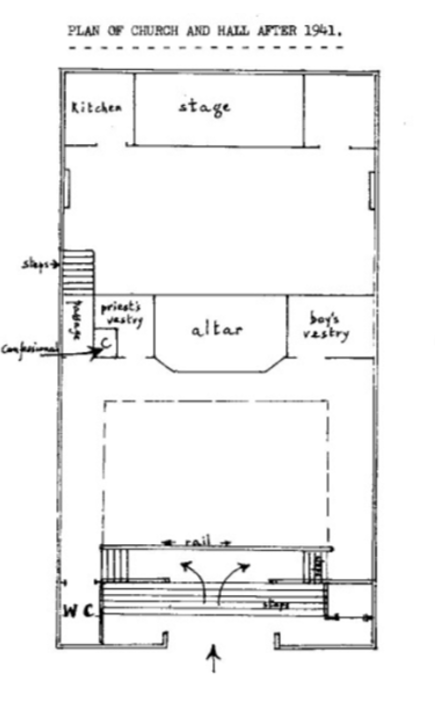
The above sketch plan, supplied by Mrs Dolan, of the Church and Hall as they were at the end of 1941 only experienced slight changes made by Fr Lynch in 1958. This configuration remained until Fr Hurley made the whole building into a church in 1965. The floor-level of the church was about four feet higher than that of the hall, with steps connecting the two. In the church-porch there were more steps going up to the doors leading into the “Standing-room” of the old cinema, with a wooden rail separating it from the church and with more steps going down to the floor of the chapel. There were the old emergency exits on either side of the hall, one of which was later transformed into the present side-door giving access to the Presbytery-yard. The original exits, however, went right to the ground, without any of the present steps. These two exit-doors, besides giving access to the hall, were also used whenever there was a Church procession. It left the Church through the front door, went along Clumber Road, across the Hall through the exit doors, then back along the side of Bulkeley Road into the church.
The tip-up cinema seats which by 1940 were in a poor condition were replaced by old iron and wood benches bought for £10 from Macclesfield District Bank as early as April 1940. All this makes one fairly certain that from the beginning of 1940, if not from September 1939, Fr Kelly was completely responsible for everything that went on in the old cinema, including the Mass for the evacuees.
A receipt for six shillings for taking Fr Kelly from Hazel Grove to Poynton makes it quite certain that the first Mass in the reconstructed chapel was said by Fr Kelly himself on the 9 November 1941, and that from then on, the priests from St Peter’s were responsible for the Sunday Mass until a resident priest was named in 1957. By the end of 1941 the number of Catholics in Poynton had increased. Not only were some of the children, teachers and grownups from Gorton still there, numbering perhaps about fifty in all, but by then other Catholics had come, attracted partly at least by the relative safety from the by then increasingly frequent and ferocious bombing. This last triggered off new evacuations, but never on the scale of 1939 and never again involving other Catholic schools in Poynton.
Hardly had the main body of evacuees left when another invasion of Catholics descended on Poynton. This came because of the USA involvement in the War from December 1941 onwards. Within the first year or so American forces were camped in Poynton, and many of them were not only Catholics, but flamboyantly so. The first big American camp was in the Park, near Poynton Pool. Then another was erected in Adlington, just off the main Road, opposite Street Lane, and so inside the present parish of St. Paul’s. Many American troops, especially from the Adlington Camp, used to come to the cinema-church in Poynton, sometimes in army trucks, sometimes in fully military parade.
At the end of 1941 the Catholics, who had scarcely arrived in Poynton and who had just acquired their first church, found themselves in the odd position of also being the sole possessors of a hall that was open to the general public for social events. They immediately started holding dances, bazaars, socials and other money-raising events to repay something of what Fr Kelly had paid for their church and hall. In this the tiny Catholic group received great support from the relatively rich Americans who were generous both in giving to the collections and also in attending the social events. In return many of the Catholics welcomed them into their homes, particularly for breakfast after the Sunday Mass. From about the end of 1942 the Catholics also organized a Canteen in their little hall every night, with a Whist Drive (not very popular with the Americans) and Dance (very popular) every Saturday night, and a Social Evening every Sunday. All these events were open to everybody, but they were organized by the Catholics and patronized mainly by themselves and the American troops.
Mrs Williamson who lived in 17 Bulkeley Road. had the keys for the church and hall, and also the responsibility for keeping the vestments, chalice, altar-wine etc. safe and dry in her home. She played a big part in organising the social events with the other Catholics. Providing refreshments was a big problem in those days of strict rationing, but somehow, they managed, and thus they were able to give a fair account of money to Fr Kelly who, in September 1943, had to pay a further £163 because of dry rot in the floor of the hall.
What the people of Poynton thought about all these Catholics has not been recorded, but it must have been something of a shock to them, particularly when the American troops were eventually replaced by Poles in the camp at Adlington. Ever since Poynton had become a mining village about 1800 it had been not only solidly Protestant but, on the whole, quite anti-Catholic, as indeed was most of England at the time. It is said that Poynton miners led the Stockport Riots in 1852 when two Catholic churches were destroyed and that afterwards they made a pact in Park Lane Methodist Church that they would never allow a Popish chapel to be erected in the village. And yet things had so changed during the War that the same Church let its hall be used as a Catholic school and nearly everybody in Poynton treated the evacuees with kindness and with active help in getting them to Mass. The arrival of the American and Polish soldiers further helped the Catholic cause. It was not in Poynton, but it was during the War, that an old lady was heard to say wonderingly. ‘You know, I never knew the Poles were so Irish.” However, old prejudices and old attitudes die hard, and even after the War there was still a fair amount of distrust of Catholics. Today, those feelings are happily a thing of the past.
THE NEW PARISH 1957 to 1960
The 1931 Census gives the population of Poynton-with-Worth as 3,944. It probably stayed about that number for the next twenty years, despite the closure of the mines. New industries came to the Poynton area and new houses were being built. About 1947 the first of the estates was started. It was built around Copperfield and Barnaby Roads. In 1954 the second, the Distaff Road Estate, was occupied. Many of the newcomers found work in the developing Aircraft Factory at Woodford. Among the new people were several Catholics, and others had already moved into the houses on Chester Road and Park Lane. At the beginning of 1957 they had grown to about three hundred, and this led Bishop Murphy, prompted by Fr Walsh who was then the Parish Priest of Hazel Grove and Poynton, to appoint Fr John Lynch as the first Parish Priest of St Paul’s. He was officially installed on Sunday 27 September 1957, and from the 4 October onwards there was for the first time in centuries a regular daily Mass. The first Presbytery was 44 Dickens Lane where it remained till 1964.
The new parish was fittingly called St Paul’s, for it was an offshoot of St Peter’s, but even more fittingly it could have been called ‘Our Lady’s’ or “St Mary’s” for it was the immediate successor to the Catholic Poynton Chapel of that title. For nearly twenty years the priests from Hazel Grove had catered for the spiritual needs of the Poynton Catholics and during all that time they had also been responsible, through their parishioners for the financial needs of their Poynton out-church. All through the forties and fifties the Catholics in Poynton had tried to help their own finances through running social events, including Bingo on all Fridays and Saturdays in the late fifties. Even with the infusion of American and Polish contributions, however, they were unable to meet all their liabilities, and it was St Peter’s people who bore the brunt. St Peter’s is our “Mother-Parish’ and all their priests, including Fr Peters and Fr Russell his predecessor, were a source of immense support for Poynton. We all owe them a great debt of gratitude, especially this writer.
With the advent of Fr Lynch, St Paul’s burst into a flurry of activities, both spiritual and social. He was young and zealous, and he flung himself eagerly into his many duties, but particularly that of getting to know his flock. Towards the end of the last century Cardinal Manning once said that England has eight Sacraments, and the eighth is the doorknocker in the hands of the priest. Fr Lynch had similar sentiments and his people responded readily to frequent visits to their homes.
Sunday Masses were at 8 and 10 a.m. with evening Devotions at 6.30. The weekday Masses were at 7.30 a.m. and 9 on Saturdays. Before his arrival Mrs Brennan, teaching then in the Stockport Convent School, oversaw the Guild of St Agnes in Hazel Grove. Several of Poynton school‑girls were in her group so she had a nucleus of members when she started the Guild at St Paul’s soon after Fr Lynch’s arrival. The members of the Union of Catholic Mothers also transferred themselves to the Poynton branch and induced others to join as well. The title was loosely interpreted to include any Catholic lady, and the first president was Miss Gertie Rourke. She had Mrs McDonald as Treasurer. A branch of the Men’s Guild was also started soon afterwards. The Catholic instruction of the many children in the State school was intensified, and the Novena to Our Lady of Perpetual Succour was started on 13 November 1957.
Along with this spiritual activity Fr Lynch also generated a great deal of enthusiasm for social events. The Parish-hall in the old cinema was in constant use, not only for the Guild meetings and Instruction classes, but also for concerts, dances, Bingo and the like. Dinner Dances and other functions were sometimes held outside the parish. At the end of 1959 a Teenage Dance Club was started. It was, however, the Union of Catholic Mothers who were the most active. After the second Mass on every Holy Day of Obligation they ran a Coffee-morning, occasionally linked with a Bring-and-Buy Sale. They had frequent Jumble Sales, and they more or less made themselves entirely responsible for boosting the Autumn Fair which had started in a small way some time earlier. Quite often they had trips for themselves, either to groups in neighbouring parishes or even to things like the Blackpool Lights. They also went every year on a short retreat.
Nearly all the social events, including those of the Women, went towards paying off the Parish debt, which in December 1957 was £3,132, mostly due to buying the house for the priest in Dickens Lane. The Parish was divided into districts, and an Outdoor Collection was made in each district every week, with Fr Lynch doing one district in turn each week. Later on, Football Pools were also started. Early in 1958 Fr Lynch was able to announce that the debt had been reduced to £2,600, and on 10 May 1960, not long before he left, he told them that the debt had been finally liquidated. They were big sums for those days, and there were many other recurring expenses.
Another event occurred early in 1958. The main altar in church was greatly improved and a Lady Altar in wood was placed next to it, on the Clumber Road side of the Church. In December of that same year Mr Walter Doyle on behalf of his family donated new benches for the whole of the church as it existed at the time. To make them fit one of the relics of the old cinema was taken away – the Standing-room space with its rail and steps. There were further changes in the porch area at the beginning of 1959 when a new Baptistery was built. In it was a Font made and donated by Mr McDonough. Later it was replaced by the present beautiful wooden Font that is now in the Sanctuary. The Baptistery, with its pretty arch and wrought iron gates remained in its original form until it was converted into the Piety Stall.
On 28 October 1959 Bishop Murphy made the first ever Episcopal Visitation to St. Paul’s. He then confirmed sixteen of the parishioners, most of them children. He was greatly impressed by all he saw and heard, not least by the quality of the singing. Even when St Paul’s was still a chapel-of-ease there had been a choir and for a time Miss Derbyshire of St Mary’s Stockport used to travel every Sunday to play the harmonium. In 1957 Mr John Hughes from Barnaby Road replaced her, and when he was unable to be present his wife took his place. Late in 1958 she asked Mrs Dolma to do it “for this once,” but that once became a permanent job, which she did for the Parish for a long period of time.
In June 1960 the news burst like a bombshell that the Bishop had decided to move Fr Lynch to Shifnal in Shropshire. He had been in Poynton for less than three years, but in that time, he had brought to birth the new parish, and when he left it was a strong infant.
THE EVENTFUL YEARS 1960 - 1974
Fr. Thomas Hurley succeeded Fr Lynch on 24 June 1960. He was a B A and was to become an expert in Canon Law, especially on questions of marriage. For many years before coming to Poynton, and for all the time he was here, he had difficulties with his health, but this did not deter him in his priestly duties. He continued and developed most of the activities started by Fr Lynch and he introduced new ones. He was totally committed to the importance of Catholic education for the young, and in his early years in Poynton he spent much of his time and energy on this. The social side of the Parish was also developed, and the Notice Books of his first years here form a catalogue of such events, held not only in the Parish-hall but also in the houses of many parishioners and in centres outside of Poynton.
Soon after his arrival Fr Hurley discovered that one of the most pressing needs was a new roof for the Church. Like most cinemas built in the twenties and thirties the owners had wanted quick profits rather than a monument to serve posterity; and Poynton was no exception. Over the years we have had quite heavy bills for repairs. When it was built the roof timbers had not been made to take slates. The first roof was made of asbestos tiles, but by 1960 these were in such a sorry state that the whole building needed reroofing in some light material. During February and March 1962 this was done in cedar shingles, light in weight but ‘guaranteed’ to last sixty years. The cost was £300. In a recent letter Fr Hurley recalls a Catholic falling off the roof during the job and escaping unhurt.
A little earlier on 3 December 1961 Mrs Gilpin, who had been in Poynton since the late thirties and had worked hard in many charitable causes, especially the Catholic one, presented the six big candlesticks that were placed either side of the Tabernacle as a parting gift in memory of her parents. In the following October the lovely wooden statue of Our Lady that is still in Church was given by Mr and Mrs Heaton in memory of their daughter Eileen who had tragically passed away at the age of twenty in December 1961.
In 1963 Fr Hurley heard that the Whites who rented the “Cinema Shop” in Bulkeley Road were thinking of giving it up. He eventually agreed with the owner, Mrs Casemore, to pay just under £3,000 for it. The Whites were not unnaturally disappointed that they could not get “the good will price”, but they got some satisfaction when Fr Hurley bought up their entire stock and then sold it off to his people. Below is an artist’s impression of the house and shop as they were in the thirties, described by the daughter of the Whites. It looks big, but in fact it was “all Front”, consisting of two downstairs rooms next to one another. One was the shop, now the Priest’s Study, with above it a small bedroom and storeroom; and the other was the living room with above another small bedroom. Between the shop and house was the front door, with the stairs leading off it. At the back of the shop there was a tiny kitchen (”eight feet by four”, the daughter’s husband said) and directly above it an equally small bathroom. The toilet was outside in a yard that was bigger than today’s. There was also a large garage, separated from the shop by a passage.
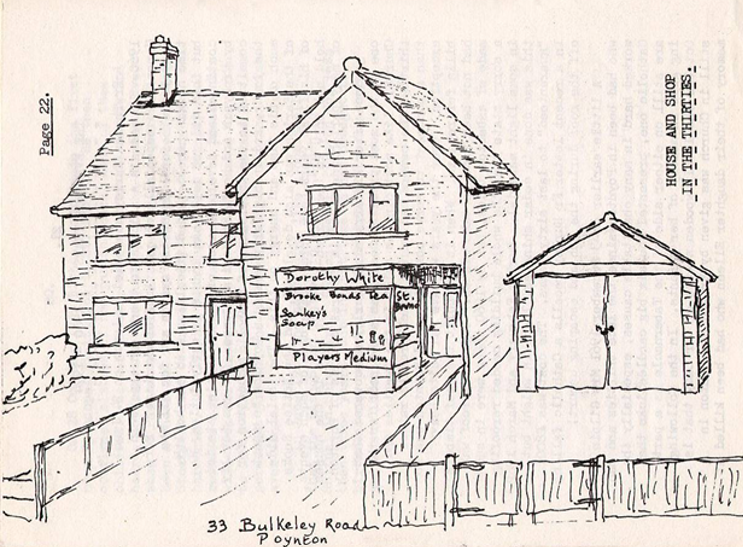
Fr Hurley’s architect built a good-sized kitchen behind the sitting-room and a housekeeper’s sitting-room behind the shop, over this last he put a big bathroom. The old garage was replaced by a reception-room, now used as a counting-room, and over this he added another bedroom, linking everything with a corridor upstairs and down. The result was a lovely, homely house, not pretentious but adequate. The renovations cost £2,850, but it meant that for the first time the priest was next to the Church and the Blessed Sacrament.
Fr Hurley moved into his new Presbytery on Tuesday 7 January 1964, and the following Saturday there was a solemn blessing of the new house in the presence of some parishioners and the recently arrived Vicar of St George’s, the Rev Bob Lewis, and his wife Joan. In those days such encounters with “our separated brethren’ were rare, and Fr Hurley and Canon Lewis both date the real birth of Ecumenism in Poynton from that day.
On Sunday 23 February 1964 at the 4.30 Service Fr Gratian of the Order of St Francis solemnly erected the Stations of the Cross. These fourteen beautiful bronze images cost £98, and the money for them was raised by the young girls in the Guild of St Agnes through various functions, under the inspired leadership of Miss Joan Seville. She was Fr Hurley’s housekeeper who had given up her nursing career to look after him. She died of cancer at the age of thirty-two on 16 August 1963. She saw the Stations before her death, and there were special prayers for her during the Blessing ceremony. Later they went quite black, but Mr Kevin Molloy cleaned and lacquered them very successfully during Lent 1979.
By 1964 the expansion of Poynton had begun in earnest. Many of the Estates had been or were being built, especially those within easy distance of Poynton Place. Fr Hurley reckoned that by then he had six hundred Catholics, and on the strength of those numbers he made his first application for a Catholic school. In that year Bishop Grasar in his first Episcopal Visitation to St Pauls confirmed thirty-three children and four adults. The numbers were such that it was becoming increasingly difficult to fit them into the tiny church for Sunday Mass. Accordingly Fr Hurley began the lengthy preparations for extending the church.
The eventual plan saw the absorption of the hall into the church and the building of the present Lady Chapel. This meant re-flooring the entire building to get it on a single level and installing the false ceiling that most people admire. The three sacristies were constructed and one of the old exits was walled up and the other turned into a door with steps leading to the Presbytery. The new altars were ordered and all the woodwork behind and above the main altar was made as well as the parquet floor of the sanctuary which was within wrought-iron and wood altar rails. All the sacristy and altar furniture was bought, gas central heating installed, a complete electrical rewiring done and finally the whole church was decorated. Mass was said for the time in the extended, but at that time unfinished church on Sunday 4th April 1965, and the whole job was completed by September. The total bill for the entire restoration came to £5,680, but this did not include the benches. These were given by the Doyle family who thus became the donors of all the benches in the church.
To find the money for these and other expenses Fr Hurley, at the end of 1964, had introduced Planned Giving to the parish by means of the Offertory Envelopes we still use. Besides encouraging people to use their discretion and generosity in supporting the church much better than the former collections did, these envelopes are particularly useful to us in Poynton owing to the kindness of the Hazel Grove priests who always return to us our envelopes when given in the collections in their church. Around the same time that the Planned Giving was started the Covenant Scheme was introduced. Through it the Government returns to the Church, or any recognized Charity, all the tax that the giver has already paid on what they are giving. Mr Smith Scoble was in charge of the Covenants when they were first started, and on his death in 1973, Mr Jim Ryder continued his work, followed for many years by Mr and Mrs Binder. From a modest beginning in the mid-sixties, it grew to nearly £3,500 a year in income for the Church which we would have to find in other ways if the government were less helpful towards deserving Charities.
Although St Paul’s had gained a great deal through extending the church so that it could now hold about 240, compared to the 120 while the church was smaller, the loss of the hall was a grievous blow. To compensate, at least partly, for this loss the old Projection room was turned into a Meeting room by moving the choir and harmonium into the main body of the church and absorbing a small storeroom into the new Meeting room. This took place at the end of 1968, and in the following July Fr Hurley, with great foresight, bought 52 Clumber Road for £3,000. It was used for a time by his new housekeeper, Miss Tessa Stubbs, but the main reason for buying it was the land that went with it. This includes the curious little building known as “The Toy Box’, which in its time has been used for a Creamery and a Butchery among other things, the wooden garage next to it, and the bits of land in front and behind. All this will be invaluable if ever we need to extend or rebuild our church, and it had other possibilities, such as a site for a temporary Meeting room. The old Projection room is not the complete answer to our “Meeting” needs.
It had always been Fr Hurley’s dream to have our own Catholic School, but it seemed a forlorn hope. St Peter’s got their first school only in 1955, and to do it they had to build it without Government help? To this day Wilmslow, which became a parish in 1914, is without its own school. Yet Fr Hurley went on applying and lobbying from 1964 onwards. Helped by a friendly County Councillor and the Catholic Educational Authorities, against all the odds, he succeeded in 1971 when unexpectedly the Department for Education and Science allocated £55,000 to build the first phase of St Paul’s Primary School in Marley Road. Before the building was completed in August 1973 the first of the great financial crises had hit the country. Fr Hurley had just made it by the skin of his teeth: This really was his greatest achievement in Poynton and the one that had the most profound effect in changing the whole spiritual atmosphere of the Parish. He had struggled for many years to ensure some form of Catholic instruction for the numerous children attending non-Catholic schools, and for a long time he paid a bus to take children to Bollington Catholic School at no cost to the parents beyond what they gave in voluntary contributions with the other parishioners. Like all priests in his position, he was hurt and disappointed by the lack of cooperation on the part of many parents, but he kept on trying … and he got his school.
It was opened in September 1973. The first phase meant the projected Infant School, with three teaching areas and a large Practical Area, plus some other rooms The final bill was just over £40,000, of which the Parish had to give about £10,000. The first Head was Mrs Shirley Hawkins and there were two other teachers, Miss Lang and Miss Lawton. On the Opening Day there were only thirty-five children, as many parents would not move their children. This too was a disappointment to Fr Hurley, but as always, he kept on trying. Gradually the numbers crept up. By May l974 there were fifty-five and the school year ended with fifty-eight children in St Paul’s. By then, however, Fr Hurley had left Poynton for Birkenhead to take up a new appointment as full-time “Officialis”, a post he had had part-time while still in Poynton. It meant that he was in complete charge of all the matrimonial cases of the Shrewsbury Diocese, and he continued in this role until Easter 1982 when, because of his worsening health, he resigned, although continued to help in a part-time capacity.
This chapter is entitled, “The Eventful Years”. In the writer’s opinion, the years that Fr Hurley spent in Poynton and the work he did in and for St Paul’s were the most eventful and the most important in all its history to date. The Presbytery and the Church, the School and the Ecumenical Movement of Poynton, every-thing in the life of this parish, bear his imprint. He formed and made St Paul’s, and we should all be extremely grateful to him.
THE CONTINUING PROCESS 1974 — 1982.
Fr Hurley left Poynton on Wednesday 1 May 1974, and that same morning – just before his departure – his successor arrived. They had, of course, met a few times already to arrange the take-over. The new priest was Fr Wilfred Jukka who belonged to the Society of Mary and Montfort (SMM) and was on loan to the Shrewsbury diocese. The title for this concluding chapter was chosen because he believed that his main task was to continue and, if possible, to develop what Fr Lynch and especially Fr Hurley had started.